
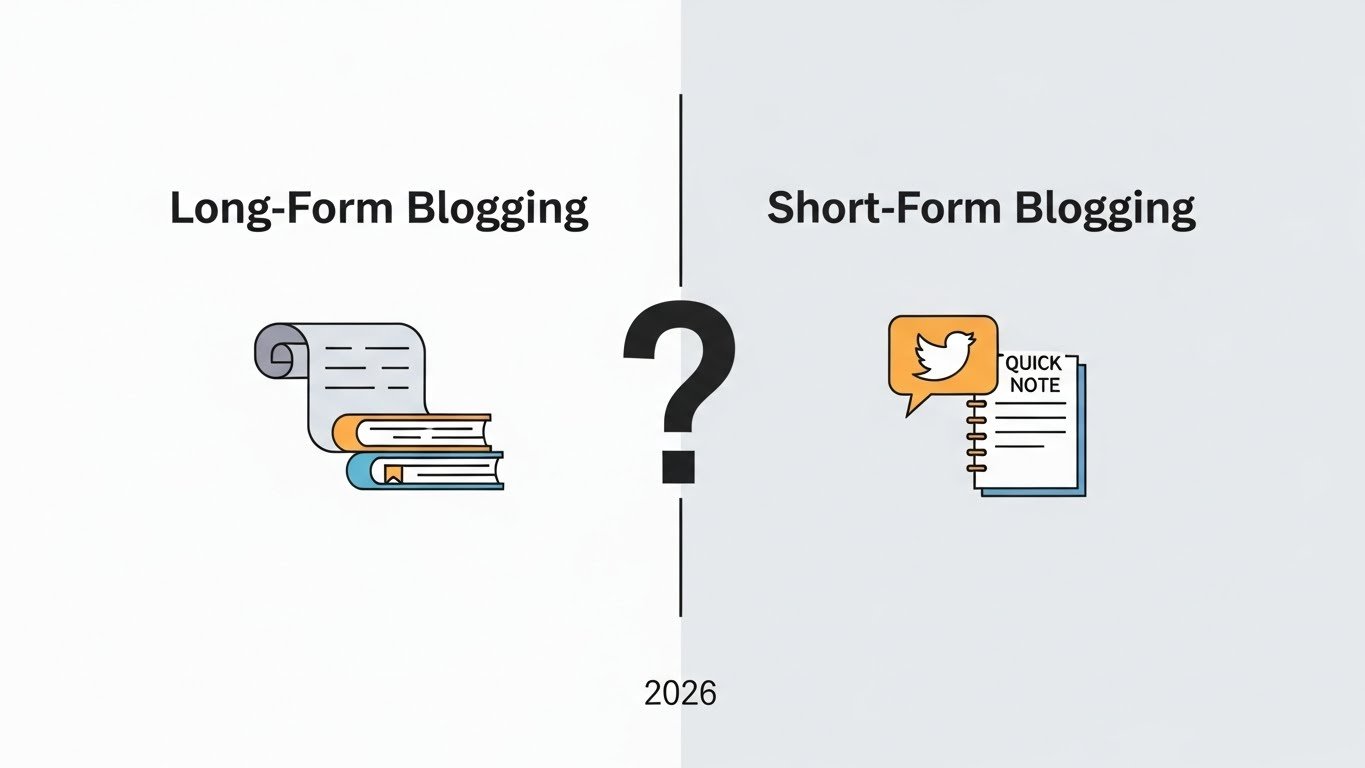
Long-Form vs Short-Form Blogging: What Works Best in 2026?
In 2026, bloggers face one big question: should content be long-form or short-form to get more traffic, engagement, and income? Search engines reward helpful, in-depth content, but audiences scroll fast and love quick posts. Choosing the right format is not about trends only; it is about strategy, goals, and how each post fits into the bigger picture of your blog.
This article explains the differences between long-form and short-form blogging, the pros and cons of each, and how to build a content strategy that keeps readers happy while giving your site strong SEO performance. The goal is to help you decide what works best in 2026 and how to optimize every post for tools like Rank Math.
What Is Long-Form Blogging?
Long-form blogging usually means in-depth articles that go into detail and cover a topic from multiple angles. These posts are often designed to become “pillar content” or “ultimate guides” on a specific keyword or problem.
Typical characteristics of long-form posts
- Length of around 1,500–3,000+ words.
- Cover a broad topic or a complete subtopic in a niche.
- Include headings, subheadings, tables, lists, images, and examples.
- Answer multiple related questions in one URL.
- Designed to rank for a primary focus keyword plus many related keywords and long-tail queries.
Long-form posts work extremely well for guides, tutorials, comparisons, reviews, and educational content. They also give enough space to naturally place internal links, external links, and CTAs (calls to action).
What Is Short-Form Blogging?
Short-form blogging focuses on quick, focused pieces of content that deliver value in fewer words. These posts target a narrower topic or a single question and are designed for readers who want a fast answer or idea.
Typical characteristics of short-form posts
- Length of around 300–800 words.
- Very focused topic (one question, one tip, one update).
- Easy to skim and read on mobile devices.
- Ideal for news, announcements, and simple “how-to” answers.
- Often shared more on social media because they are quick to consume.
Short-form posts are helpful when you want to publish more frequently, keep your blog fresh, and capture search traffic for very specific long-tail keywords or trending topics.
Long-Form vs Short-Form: Key Differences
The table below summarises the main differences between long-form and short-form blogging in 2026.
| Aspect | Long-Form Blogging | Short-Form Blogging |
|---|---|---|
| Typical word count | 1,500–3,000+ words | 300–800 words |
| Content depth | Deep, comprehensive | Light, focused |
| SEO potential | High: multiple keywords, long-tail queries | Medium: good for specific questions |
| Time to produce | Slower, more research and editing | Faster, easier to publish regularly |
| Reader intent | Research, learning, decision-making | Quick answers, inspiration, updates |
| Best use case | Guides, comparisons, tutorials, pillar posts | News, short tips, trend posts, micro-topics |
Understanding these core differences helps you match the right format to the right intent and keyword.
Benefits of Long-Form Blogging in 2026
Long-form content continues to perform strongly in 2026 because search engines reward pages that fully answer a user’s query and keep visitors on the site for longer.
1. Stronger SEO and higher rankings
Long-form posts give more space to:
- Naturally include a focus keyword and multiple secondary keywords.
- Answer many related questions in one article (great for featured snippets and People Also Ask).
- Add internal links to related posts to strengthen your site structure.
Because of this, long-form content often attracts more organic search traffic over time, especially on evergreen topics.
2. More authority and trust
A detailed article shows that the blogger understands the topic and cares about helping the reader. When a post goes deep, includes real examples, and addresses doubts, it feels more trustworthy. This makes long-form posts ideal for:
- Building authority in your niche.
- Generating leads (email signups, inquiries, product sales).
- Earning backlinks from other sites that reference your guide.
3. Better engagement and conversion opportunities
A long article gives you more opportunities to:
- Place CTAs (newsletter subscription, free download, links to services).
- Add images, charts, and quotes to keep readers engaged.
- Educate the reader step by step before asking them to take action.
For example, a 2,500-word guide on “How to Start a Blog” can include CTAs for hosting, themes, SEO tools, and your services, all in one piece of content.
Benefits of Short-Form Blogging in 2026
Short-form content remains important because not every topic needs a long article. Many users just want a quick answer or one simple technique.
1. Faster content production and publishing
Short posts can be:
- Planned and written more quickly.
- Ideal for daily or frequent publishing schedules.
- Great for testing new keywords and content ideas before investing in long-form content.
This speed helps small bloggers and freelancers stay consistent, which is a key ranking and branding factor.
2. Perfect for simple queries and mobile readers
When the search intent is simple, a short answer is best. For example:
- “How to center text in CSS?”
- “What is long-form content?”
- “Best time to post on Instagram?”
In these cases, a short post can fully satisfy the user and still rank well, especially when the competition is low.
3. Support for social media and email
Short-form blog posts also work:
- As content you can promote easily via email newsletters.
- As landing pages for social media traffic.
- As summaries that link to your longer guides.
They help drive traffic into your ecosystem and can push readers toward deeper content.
Which Works Best in 2026: Long-Form or Short-Form?
The most honest answer: both work, but not for the same purpose. The best blogging strategy in 2026 combines long-form and short-form posts in a smart way.
When long-form works best
Use long-form content when:
- The topic is complex and needs explanation (strategy, step-by-step guides, comparisons, tutorials).
- You want to rank for competitive keywords or create “pillar content” for your niche.
- You want the article to generate leads, sales, or long-term passive traffic.
Examples:
- “Complete Guide to SEO for Bloggers in 2026”
- “How to Start a Profitable Tech Blog Step by Step”
- “The Ultimate Guide to Long-Form vs Short-Form Content”
When short-form works best
Use short-form content when:
- The topic is narrow and can be fully answered in a few paragraphs.
- You want to react quickly to trends or news.
- You are answering a specific question your audience asks often.
Examples:
- “What Is a Slug in WordPress?”
- “3 Quick Tips to Improve Blog Readability”
- “How Often Should You Post on Your Blog?”
Building a Mixed Content Strategy
Instead of choosing one format forever, build a content plan that uses both.
Step-by-step mixed strategy
- Define your core topics (pillars).
List 5–10 main topics in your niche that deserve long, detailed guides. - Create long-form pillar posts.
For each pillar, write a 1,500–3,000+ word article that covers the subject in depth and targets a strong focus keyword. - Identify smaller, related questions.
From each pillar topic, extract multiple “micro-topics” that can become short-form posts. - Publish short-form support posts.
Write 300–800 word posts answering those smaller questions, and link them to the main pillar article. - Interlink everything.
Make sure pillar posts link to short posts and short posts link back to the pillar. This improves user experience and internal linking. - Update and expand.
Over time, turn successful short posts into longer guides, and refresh older long-form content with new sections and FAQs.
This hub-and-spoke or pillar-and-cluster model is excellent for SEO and works very well with Rank Math’s internal link suggestions.
Also read: Why Fiverr Is the #1 Platform for Affordable and Best in 2026
How to Optimize Long-Form Posts for Rank Math
To get a “green” score in Rank Math, your long-form posts should follow on-page SEO best practices.
1. Choose the right focus keyword
- Pick a clear, specific keyword that matches search intent.
- Make sure the focus keyword appears:
- In the SEO title (ideally at the beginning).
- In the meta description.
- In the URL slug.
- In the first paragraph.
- Several times naturally in the content and headings.
2. Use headings and structure properly
- Use one H1 (the main title).
- Break content into logical H2 and H3 sections.
- Include variations of your focus keyword and related terms in headings where natural.
- Keep paragraphs short and readable.
3. Optimize for readability
Rank Math and readers prefer:
- Short sentences where possible.
- Bullet points and numbered lists.
- Clear language without unnecessary jargon.
- Strong subheadings that describe what each section covers.
4. Add internal and external links
- Link to your other relevant blog posts (internal links).
- Link to high-quality, authoritative external sources where relevant.
- Make your anchor text descriptive, not just “click here”.
5. Use images and media
- Add at least one image (more for long posts).
- Use descriptive file names and alt text that relate to the topic.
- Compress images for faster loading.
6. Technical on-page details
- Keep your URL short and keyword-focused.
- Write a compelling meta description that includes the focus keyword and encourages clicks.
- Make sure the content is mobile-friendly and loads quickly.
How to Optimize Short-Form Posts for Rank Math
Short-form posts can also score well in Rank Math when they are focused and clean.
1. One post, one purpose
- Target one main question or micro-topic per post.
- Use the focus keyword in the title, first paragraph, and one or two headings.
2. Direct, helpful answers
- Answer the main question clearly in the first 2–3 sentences.
- Add a small amount of context or examples, but do not stretch the content just to add words.
- Use simple lists or steps if it suits the topic.
3. Connect short posts to your bigger strategy
- Add internal links to related long-form guides.
- Use short posts to drive traffic to your most important pillar pages and offers.
- Update short posts when information changes, so they stay relevant.
Common Mistakes Bloggers Make in 2026
Whether using long-form or short-form content, some mistakes can harm results:
- Publishing long posts with no real depth or unique value.
- Writing short posts that are so thin they do not answer the question properly.
- Ignoring internal links and leaving posts isolated.
- Stuffing keywords instead of writing naturally.
- Forgetting to optimize titles, meta descriptions, and URLs for the focus keyword.
Avoiding these mistakes helps both formats perform better and improves your Rank Math scores.
FAQ: Long-Form vs Short-Form Blogging in 2026
Q1: Is long-form content always better for SEO?
Long-form content often performs better for complex topics and competitive keywords, but it is only better when it is genuinely helpful, structured, and well optimized. Poor-quality long content will not outrank a strong shorter article.
Q2: Can short-form posts rank in 2026?
Yes. Short-form posts can rank well for narrow, specific queries where users want quick answers. They are especially effective for low-competition and long-tail keywords.
Q3: How often should I publish long-form posts?
Quality matters more than quantity. Many blogs do well publishing one strong long-form article per week or even per month, supported by shorter posts and updates.
Q4: Should I turn every short post into a long post?
Not necessarily. Some topics are simple and do not need more words. Instead, expand posts when the topic clearly has more depth and search demand.
Q5: How can I use both formats together?
Create long-form pillar guides for main topics and short-form posts for related micro-questions. Use internal links to connect them and guide readers through your content.
Conclusion: What Works Best in 2026?
In 2026, the most effective blogging strategy is not choosing only long-form or only short-form content. Long-form blogging is best when you want to rank for competitive keywords, build authority, and drive conversions with in-depth, structured articles. Short-form blogging is best when you want to publish quickly, target specific questions, and support your larger content strategy.
For the strongest results and the best chance of getting full green scores in tools like Rank Math, use a mixed approach:
- Create powerful long-form pillar posts optimized around clear focus keywords.
- Support them with short, focused posts that target micro-topics and long-tail queries.
- Optimize every post for readability, structure, internal linking, and user intent.
When you balance both formats and follow on-page SEO best practices, your blog is positioned to perform well in search engines and provide real value to readers throughout 2026 and beyond.